
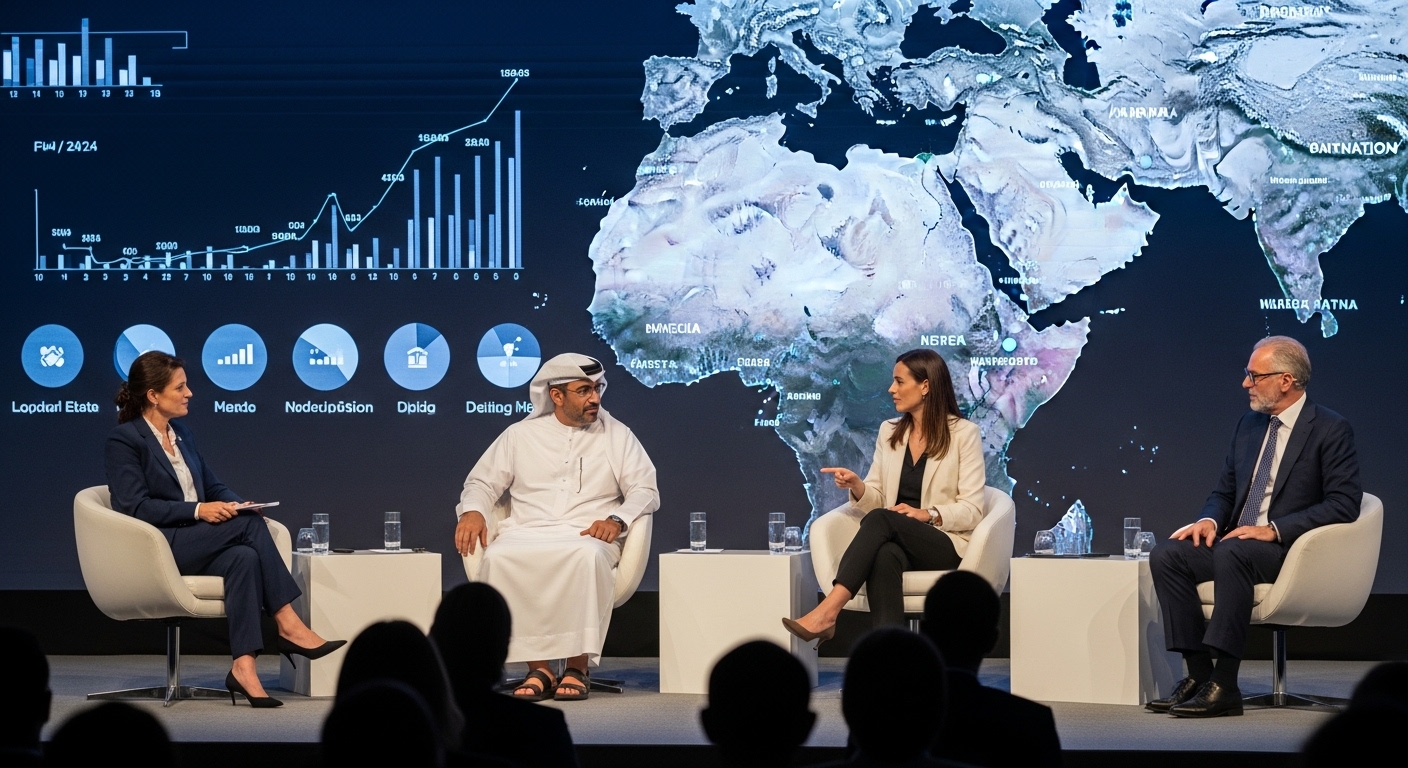

From interest rates to geopolitics — what’s pushing prices up or down?
If there’s one thing I’ve learned watching real estate markets over the years, it’s this: property prices don’t move in isolation. They’re downstream of bigger forces — money, politics, risk, and sometimes outright conflict.
Right now, nowhere illustrates that better than the Middle East.
From Dubai’s record-breaking property boom to sudden investor hesitation triggered by geopolitical shocks, the region has become a real-time case study of how global economic trends shape real estate — often faster than most people expect.
Let me break down what’s really going on.
1. Interest Rates: The Invisible Hand Behind Property Prices
At the core of any real estate market is the cost of money.
When interest rates are low, borrowing is cheap — developers build more, buyers stretch further, and prices rise. When rates climb, everything tightens.
We’re currently in a volatile phase. Global mortgage rates have started rising again — for example, U.S. mortgage rates recently climbed to about 6.1%, reflecting uncertainty in global bond markets. That might sound distant, but capital is global — and so is its cost.
Why does this matter for the Middle East?
Because much of the region’s real estate demand — especially in hubs like Dubai — is driven by international investors and leveraged buyers. When financing becomes more expensive globally, demand softens.
There’s also a second-order effect: Geopolitical tensions are pushing up oil prices, which feeds inflation, and inflation keeps interest rates higher for longer.
So even if local fundamentals are strong, global monetary policy can quietly put a ceiling on price growth.
2. Geopolitics: The Fastest Way to Reprice Real Estate
If interest rates are the slow-moving force, geopolitics is the shockwave.
The ongoing conflict involving Iran has already demonstrated how quickly things can change. The disruption of the Strait of Hormuz — a route responsible for roughly 20% of global oil supply — sent oil prices above $100 per barrel and shook global markets.
And here’s where it gets interesting for property:
- Rising oil prices → higher inflation
- Higher inflation → higher or delayed interest rate cuts
- Higher rates → reduced affordability and investment
It’s a chain reaction.
We’re already seeing the sentiment shift. Real estate markets globally have become more cautious, with investors adopting a “wait-and-see” approach amid uncertainty.
Even in the Gulf, markets have shown sensitivity. Dubai’s equity markets, for instance, dropped amid investor caution linked to war risks — and real estate rarely moves independently of broader investor sentiment.
In short: Perceived stability is a core asset in real estate, and geopolitics directly affects that perception.
3. Oil Prices: The Double-Edged Sword
The Middle East sits in a unique position because of oil.
When oil prices rise:
- Governments earn more revenue
- Infrastructure spending increases
- Liquidity flows into local economies
This often boosts real estate demand, especially in Gulf Cooperation Council (GCC) countries.
But there’s a twist.
The same oil price surge also:
- Drives global inflation
- Forces central banks to stay hawkish
- Increases construction and energy costs
So while oil wealth can push prices up locally, the global consequences can slow down demand and financing simultaneously. That tension is one of the defining dynamics of Middle Eastern real estate today.

4. Capital Flows: Why Dubai Keeps Winning (For Now)
Despite all the volatility, cities like Dubai continue to attract global capital — and the numbers are striking.
- Property prices in Dubai have surged dramatically, rising over 120% since 2020. In just the first half of 2025, property sales reached AED 431 billion, up 25% year-on-year.
This isn’t random. Dubai has positioned itself as:
- A safe haven for global wealth
- A tax-efficient jurisdiction
- A politically stable hub (at least relative to alternatives)
During periods of global uncertainty — whether it’s the war in Ukraine or capital flight from emerging markets — money looks for safety. And increasingly, it lands in Middle Eastern real estate.
We saw this clearly after 2022, when foreign investment (including billions from Russian buyers) flowed into Dubai property.
But here’s the catch: These flows are highly sensitive to global risk perception.
If geopolitical tensions begin to threaten regional stability directly — as recent attacks and disruptions suggest — that same capital can pause or redirect just as quickly.
5. Investor Psychology: The Underrated Driver
Beyond data and economics, there’s something less tangible but just as powerful: confidence.
Real estate transactions rely heavily on long-term expectations. When uncertainty rises:
- Buyers delay purchases
- Developers postpone projects
- Lenders tighten credit
Recent surveys already show declining buyer confidence and weaker activity in property markets affected by geopolitical uncertainty.
And this matters more in the Middle East than in many regions because:
- A large share of buyers are international
- Many purchases are discretionary (investment, not necessity)
In other words, sentiment can move the market faster than fundamentals.
6. So What’s Actually Pushing Prices Up or Down?
If I had to simplify the current forces shaping Middle East real estate, I’d break it down like this:
Upward Pressure on Prices
- Strong oil revenues and government spending
- Continued inflow of global wealth into safe-haven cities
- Population growth and urban expansion
- Limited supply in prime areas
Downward (or Cooling) Pressure
- Rising or persistent global interest rates
- Geopolitical instability affecting investor confidence
- Higher construction and financing costs
- Slower cross-border investment decisions
And right now? These forces are colliding.
Final Thoughts: A Market Defined by Contradictions
What makes Middle East real estate fascinating today is that it’s being pulled in opposite directions at once. On one hand, you have:
- Record demand
- Strong capital inflows
- Ambitious development visions
On the other:
- War-driven uncertainty
- Volatile interest rate expectations
- Fragile investor sentiment
The result isn’t a simple boom or bust.
It’s a selective market — where prime assets in stable, globally connected cities continue to perform, while everything else becomes far more sensitive to global shocks.
And if there’s one takeaway I keep coming back to, it’s this:
Real estate in the Middle East is no longer just a regional story — it’s a global macro trade, shaped as much by central banks and geopolitics as by supply and demand on the ground.

minoxidil pk technical overview
minoxidil pk technical overview
sinusitis clinical details
sinusitis clinical details
Drug Absorption Resource
Drug Absorption Resource
Sildenafil vs Levitra Onset Evidence
Sildenafil vs Levitra Onset Evidence
sildenafil and cGMP
sildenafil and cGMP
this guide to sildenafil
this guide to sildenafil