

Which cities and communities are set to outperform—and why?
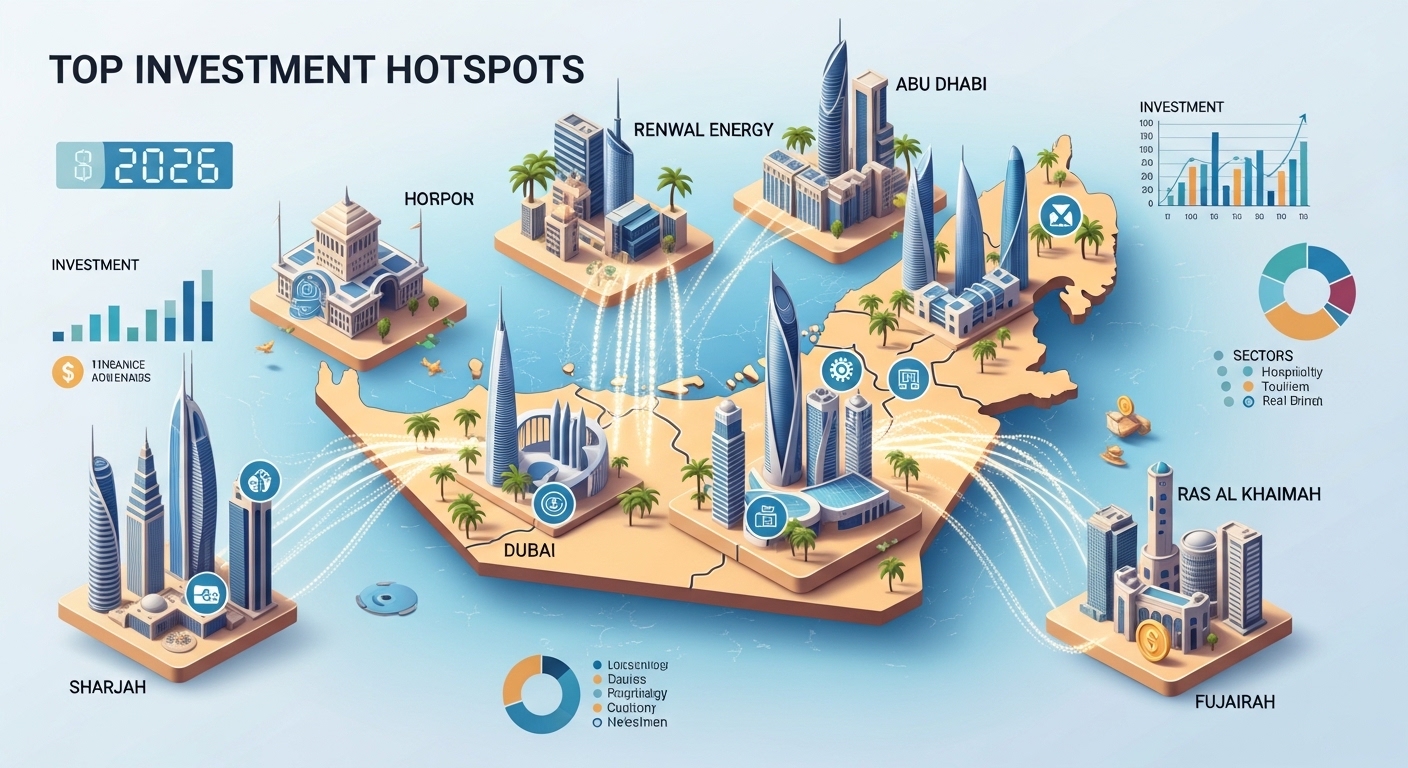
If you’ve been watching the UAE property market over the past few years, you’ll notice something important: this is no longer a one-city story.
For a long time, everything revolved around Dubai. Today, the smart money is spreading across multiple emirates—and even more interestingly, into specific micro-communities within those emirates.
As we move deeper into 2026, the question isn’t whether to invest in the UAE—it’s where exactly the next outsized returns will come from.
Let me break down the cities and communities I believe are positioned to outperform—and more importantly, why.
1. Dubai: Still King—But Now a Game of Precision
Dubai remains the UAE’s most liquid and internationally recognized property market. In 2025 alone, the market saw transaction value growth of over 30% year-on-year, driven by population inflows exceeding 200,000 new residents.
But here’s the shift:
Dubai is no longer about “buy anything and win.” It’s about buying in the right communities.
Top-performing communities for 2026:
- Business Bay
- Jumeirah Village Circle (JVC)
- Dubai Hills Estate
- Dubai South
- Palm Jebel Ali (emerging luxury play)
Why these areas are outperforming:
1. Infrastructure-led growth
Dubai South, for example, is anchored around Al Maktoum International Airport and Expo City—two long-term economic drivers.
2. Rental yield strength
In communities like JVC, investors are still achieving high occupancy with minimal vacancy, thanks to mid-market affordability and strong tenant demand.
3. Lifestyle ecosystems
Dubai Hills Estate isn’t just housing—it’s schools, retail, parks, and healthcare bundled together. That’s what drives both rental demand and resale value.
4. Capital appreciation (still strong, but moderating)
Dubai is expected to deliver ~8–12% price growth in 2026, which is solid—but no longer explosive.

My take:
Dubai remains essential—but the edge now comes from targeting emerging master-planned communities, not legacy prime areas.
2. Abu Dhabi: The Quiet Outperformer
If Dubai is the headline, Abu Dhabi is the story smart investors are quietly accumulating around.
Here’s the data point that caught my attention:
Abu Dhabi real estate transaction value surged by 79% year-on-year in 2025.
That’s not hype—that’s structural growth.
Key hotspots:
- Al Reem Island
- Yas Island
- Saadiyat Island
- Al Maryah Island (emerging)
- Hudayriyat Island (future lifestyle hub)
Why Abu Dhabi is outperforming:
1. Earlier stage of market maturity
Compared to Dubai, Abu Dhabi is still in a price discovery phase, meaning there’s more upside left.
2. Strong population and capital inflows
Demand is being driven by long-term residents—not just speculative investors.
3. Limited supply + high-quality development
This is a powerful combination. Fewer units + rising demand = sustained price pressure.
4. Lifestyle-driven demand (especially waterfront)
Communities like Yas and Saadiyat combine:
- Beaches
- Cultural districts
- Entertainment hubs
This is where global buyers are increasingly looking.
Real example:
Some areas, like Al Reem Island, saw significant price growth (~30%+ in certain segments) due to demand concentration and affordability relative to Dubai.
My take:
If Dubai is about yield and liquidity, Abu Dhabi is about medium-term capital appreciation with lower volatility.
3. Sharjah: The Yield Play Most Investors Ignore
Sharjah doesn’t get the same headlines—but it probably should.
Key hotspots:
- Al Nahda
- Al Majaz
- Al Khan
- Muwaileh
Why Sharjah is compelling:
1. High rental yields (7%–9%)
That’s significantly higher than most Dubai areas.
2. Price arbitrage vs Dubai
Rental costs can be 30–50% lower than in Dubai, attracting a massive commuter population.
3. Consistent demand from end-users
Unlike speculative markets, Sharjah is driven by real housing needs.
4. Stable (but slower) appreciation
Expect 4–6% annual growth, not explosive — but reliable.
My take:
Sharjah is ideal if your strategy is:
- Cash flow
- Portfolio diversification
- Lower entry price
Not hype—but dependable returns.

4. Ras Al Khaimah: The Emerging Wildcard
This is where things get interesting.
Ras Al Khaimah (RAK) is increasingly being positioned as the UAE’s next tourism and lifestyle investment hub.
Why investors are watching RAK:
1. Major tourism-driven developments
Integrated resorts and mega projects are reshaping demand patterns.
2. Lower entry prices + high upside potential
Still early in the cycle—this is where early investors typically win.
3. Strategic diversification by the UAE government
RAK is part of a broader push to decentralize growth beyond Dubai.
My take:
Higher risk, higher upside.
This is a 5–10 year play, not a quick flip.
5. The Macro Trends Driving All Hotspots
Across all emirates, a few themes explain why these locations are outperforming:
1. Population growth
Dubai alone added over 200,000 residents in a single year, directly fueling housing demand.
2. Economic diversification
From tech to tourism to finance, the UAE is reducing oil dependence—making real estate demand more sustainable.
3. Infrastructure investment
Massive projects—from transport corridors to new airports—are creating new micro-markets overnight.
4. Shift toward end-users
More buyers are purchasing homes to live in, not just flip—stabilizing the market.
Final Thoughts: Where I’d Put My Money in 2026
If I had to simplify it:
- Dubai → Best for liquidity + rental income (but choose carefully)
- Abu Dhabi → Best for capital appreciation + stability
- Sharjah → Best for high-yield, low-entry investing
- RAK → Best for long-term speculative upside
The real opportunity in 2026 isn’t just picking a city—it’s understanding where growth is being engineered through infrastructure, policy, and population movement.
That’s where the next wave of returns will come from.
terbinafine side effects complete guide
terbinafine side effects complete guide
acular ketorolac indications
acular ketorolac indications
ketorolac tromethamine metabolism
ketorolac tromethamine metabolism
PDE5 inhibitor action pathway
PDE5 inhibitor action pathway
pneumonia diagnosis
pneumonia diagnosis
Sildenafil vs vardenafil PK comparison
Sildenafil vs vardenafil PK comparison
Sildenafil vs Cialis Duration Analysis
Sildenafil vs Cialis Duration Analysis
Sildenafil vs Avanafil Onset Profile
Sildenafil vs Avanafil Onset Profile
sildenafilcentral.com
sildenafilcentral.com